The Four Pillars of Business Wealth for Privately-Held Companies
When my family and aunt and uncle acquired a small 22 room seasonal hotel in 1979 when interest rates were 23%, they weren’t focused on building their business wealth. They were aiming much lower and wanted a small business at the lake where the families could gather and hopefully the business would make a little money, or at least break even.
Well, after many challenging years, they eventually got what they were aiming at.
In my 27 years of business experience advising hundreds of companies in 62 industry segments from six countries, I’ve seen highly effective and profitable growth strategies, and I’ve seen disasters. From all of this, I’ve discerned that there are four pillars to building business wealth.
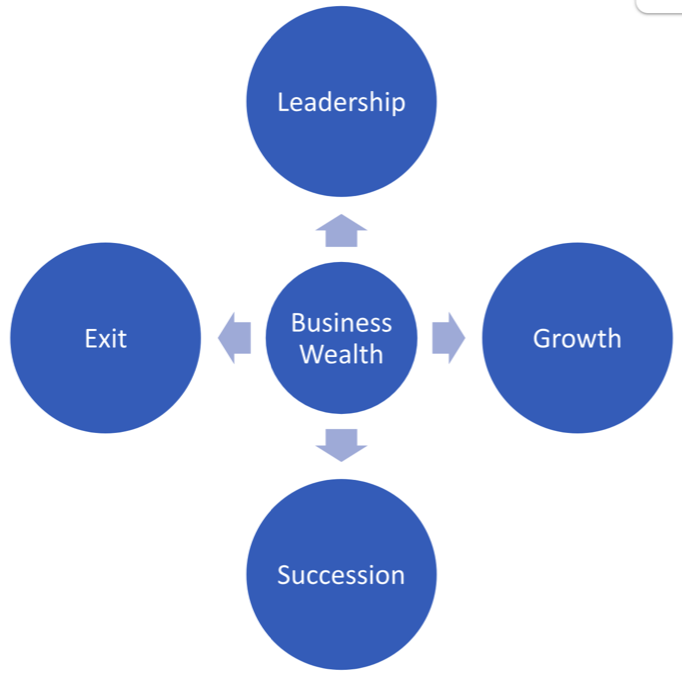
The four pillars are:
Leadership
Growth
Succession
Exit
Figure 14.1: The four pillars of building business wealth.
Leadership
The number one critical success factor of success in any organization is leadership. Period. A great leader’s number one job is to create more leaders.
Your executive team that you have in place today is the limiting resource on your capacity to build your business wealth.
Growth
Every entrepreneur is driven by growth. Just like a tree that keeps growing, business growth is part of an entrepreneur’s DNA.
There are many types of growth so let’s focus on what’s most important and measurable. These include:
Revenue – this represents our value to our customers, which is a function of our strategy.
Profit – this is more important than revenue.
Valuation – this is a function of profit.
Customer loyalty – their purchase history, volumes, trends.
Leadership and talent – are you training and growing your people?
Capacity – can you scale your business to three times as large?
Succession
Succession planning is about two things: management and ownership. Too often, people think it’s about death and taxes. It’s not.
The best place to start is with your management team. What are their strengths? What is their capacity for leadership growth from training, experience, and coaching? Do you have the right people in place to run your company when it’s twice as large in five years?
Ownership succession is about having a long-term plan in place to create, protect, and transition your business wealth to your family and shareholders.
Exit
The best managed businesses are prepared to acquire or be acquired at all times. In other words, you’ve maximized the valuation continually from growth, putting a strong management team in place, and making yourself redundant.
If you’re not yet redundant, you may need to fire yourself and learn how to become redundant quickly. That step alone will increase the value of your company and build your business wealth.
Bonus – Leave a Legacy
The final point of building your business wealth is to leave a legacy. It doesn’t take a lifetime to create a legacy; you can do it in an instant by beginning to formalize your business wealth building plan. By having the people, systems, and structures in place, you can ensure the value of your company is protected in the event that you just might happen to not live forever.
From the Vault
Business wealth is having the time, energy, health, and money to enjoy your life as much as possible, without worry, fear, and guilt. Our business needs to provide that for us. How is your business wealth?
What’s New
We’re making progress on our first annual SME Business Wealth Builder conference that will be held in Whistler, BC on October 10-11, 2018. This event is for business owners of small and medium companies who want to grow their businesses and maximize their business wealth.
We’re in negotiations with some fancy hotels who are being very aggressive with their pricing due to the non-peak season timing. I’ll be sending out more details shortly. If you’re interested, let me know, and I’ll add you to the invitation list.
Call to Action
Assess your business wealth in terms of:
Leadership – do you have the people, or can you grow them, to run your business at double the size?
Growth – how much has your business grown and your wealth grown?
Succession – do you have plans for management and ownership succession?
Exit – what’s your exit strategy in a controlled situation and if you don’t have control?


