How and Why to Keep Score
As kids, we always kept score. We played hockey until someone reached ten. It didn’t matter whether we were playing street hockey, baseball in the front yard (until we broke the door’s window), football in the back yard (away from all breakables), tennis, or anything else that occupied our time, we always kept score, Oh, and our games had to comply with my mother’s number one rule: “Get outside!!”
Let’s Get Personal
In our personal lives, I find many people don’t keep score of the important things and, as a result, are often chasing the unimportant things. They’re feeling frustrated and unproductive and don’t know why.
I know why. They’re not pursuing their goals, they’re not using their talents effectively, and they’re not in control.
I’ve recently written about goals. Goals are healthy and important. But how do you achieve your goals?
The easiest way is to schedule time each week to make progress on your goals. That involves reflecting on what happened last week. It involves planning on what you want to happen next week. If you don’t plan what you want to achieve next week, someone else will plan it for you.
Since we all have 24 hours in a day, and some people are much more productive than others, here are some secrets I’ve learned from observing and coaching others to achieve their goals.
The most productive people say “No” more often to things that aren’t important.
For the things that are important, they block out time and distractions. They’re masters of the “Daily Productive Unit” where they schedule time for themselves and stick to it as if it’s an important client meeting, to get things done.
Read Cal Newport’s great book, “Deep Work” if you want to learn more about this concept. Another great book on our personal energy and productivity is “When” by Dan Pink. The ultimate book for entrepreneurs is “The Effective Executive” by Peter Drucker.
Productive people say no, they’re protective of their own time, and they’re assertive because they know the opportunity cost of wasting their time.
Now, you don’t need to be highly assertive to do these things.
You do need systems and habits to help you increase your chances of success.
You do need a clear vision of your priorities.
You do need buffers to protect you from distractions.
You might need someone to hold you accountable, to coach you, and to support you.
Ironically, despite having calendars and timers on our smart phones to help us be more productive, the phones usually create more distractions.
Here are things to keep score of in your personal or work life: (Disclaimer: if you’re an employee, your boss’s goals are your goals, so you may need to clarify what those are for your own security and sanity.)
How many times do you say: “No, sorry (in case you’re Canadian), I don’t have time for that right now (the explanation is optional, and it may trigger more discussion, which is to be avoided.)”
How many “Daily Productive Units” (or DPUs) do you schedule in one week? Two to three is lots. Start with one.
How many DPUs did you achieve in the day and the week?
What is your satisfaction rating with your DPU production?
How can you improve it next week?
Table 45.1 Keeping Score
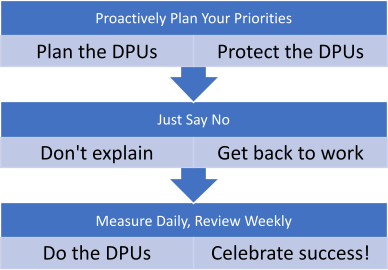
I hereby give you permission to be more assertive, say “No!” more often, and be more selfish with your energy, time and calendar.
Your clients, your family, and the economy will all thank you when you’re more productive, more profitable, and more wealthy.
From The Vault
Productivity isn’t about fancy calendars, timers, color coding your Outlook, or efficiency. It’s about protecting your energy, staying focused on your priorities, and shutting out distractions. It’s about proactively choosing where your attention goes instead of letting others, often without permission or importance, deciding your fate.
When you keep score, it’s easier to focus on your priorities.
Keep your goals and your scoreboard in front of you. That would be a good job for your smart phone.
Did You Know
If you start small and only achieve two Daily Productive Units per week, you will have achieved one hundred of them in a year! That’s a lot of progress on what is important in your life.
What would you like to achieve in the next year? Put the steps and actions in your calendar each week.
As a business owner, are you thinking this is just another crazy idea? Are you too busy? That’s the best problem to have in business! Give me a call and let’s talk about the potential impact to your business if you spent 50 hours - about an hour a week, or one full week - working on your most important priority.
Need more motivation? For every $100,000 of EBITDA you add to your company’s performance, your business valuation - and your wealth - will increase by $500,000. That’s a phenomenal Return On Investment for your time and discipline.
Some people spend more time planning their vacations than they do how to build their business wealth. What are you keeping score of in your business?
Here is an example of what can happen when you focus on one opportunity…
In the words of Dan Weedin, one of my coaching clients: “Phil coached me on an opportunity and helped me land my largest client ever, by a factor of three times larger than any previous client. Phil coaches you on strategy and how to implement to get results, quickly!”
Have a productive week, and you’ll achieve your goals!
Full speed ahead!
Thanks for reading.


