Effective Oversight of Strategy – What’s Your Process?
Every time I get on an airplane, I’m grateful the pilots are following their checklists. They’ve got their iPads out and are walking through the checklists, never relying on their memory to do something they’ve done thousands of times. They’ve got a process!
In this issue, we’ll continue to discuss the framework of strategy oversight by looking at Performance, the final major area of strategy. Performance includes three sections: the process of setting the strategy, measuring results on an ongoing basis, and maintaining your perspective as an advisory/board member. Today, we’ll discuss the process.
Figure 130.1 Strategic Oversight Framework
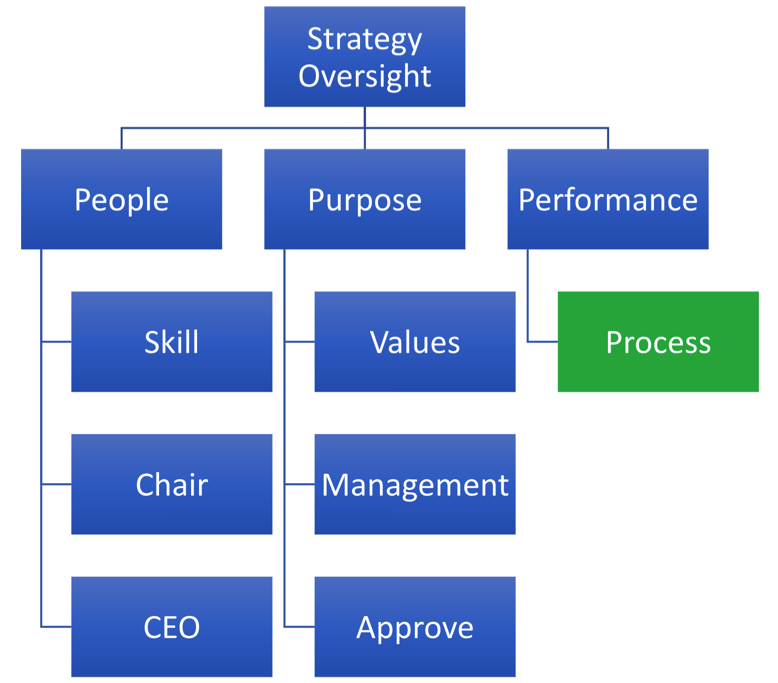
PERFORMANCE
This is about the organization’s ability to develop and implement strategy to generate consistent and predictable results. Every company is striving to meet or exceed its budget targets. This includes public companies who have quarterly earning calls and predictions along with high growth privately-held companies that are aiming to make their customers, shareholders, and bankers happy.
Process
Following a documented process on a regular basis is common best practice. Airline pilots and brain surgeons follow checklists and procedures. These are beneficial for business, too.
Agenda – Every good meeting needs an agenda – and an effective chair person. There are many versions of strategic planning available. Since strategy is about defining your ideal future and developing a plan to achieve it, the agenda should focus on the future state, the external market, your customers, and your competitors. Don’t allow the agenda to drown you in your own data. A good agenda provides plenty of time for healthy and open discussions about possibilities, assumptions and risks are, and realistic and optimistic goals that will get people committed and excited to take action.
Committees – Assigning responsibilities for the development and implementation of strategy to committees can enable the board and management to work together effectively. The committee can conduct preliminary discussions with management and reviews of the strategic plans. The committee can have specific functions such as evaluating strategic acquisition alternatives. Committees are designed to make the overall board more effective and efficient by performing some of the detailed work outside of the general board meeting. Just make sure the committee is focused on results, which we’ll discuss in a later issue.
Time – What is the single most important strategic initiative that you want to accomplish in the next year? Is it to improve profitability at current revenue levels, or to boldly expand into new markets? Avoid setting too many initiatives that end up diluting each other. Allocate resources – time, people, money, and energy – to achieve the most important objectives within a tight time frame, and ignore what might be interesting or shiny but isn’t important to your customers or your bottom line.
The process of developing, approving, implementing, and monitoring strategy is some of the most important work that an organization can do. This is what delivers value to your customers, creates a sustainable competitive advantage, and provides returns to your shareholders.
Whether you’re a public company board member or a private business owner, you need a process. By following a process, you ensure the basics are covered while increasing efficiency and effectiveness so you have even more time to be innovative and create a sustainable competitive advantage.
What’s your process?
If you’d like help developing or enhancing your strategy process, give me a call.
TTD 134 Effective Oversight of Strategy – Perspective
At a board meeting with new board members that I was facilitating, the first things the new members asked for was a detailed explanation of the current financial position, the status of performance on major projects and initiatives, and what the major risks facing the organization were. That’s a great perspective for any board member to have, especially when joining (or before joining) a board.
I want to wrap up this series on how a board (or executives and owners) can provide more effective oversight of strategy by talking about perspective.
Figure 134.1 Strategic Oversight Framework
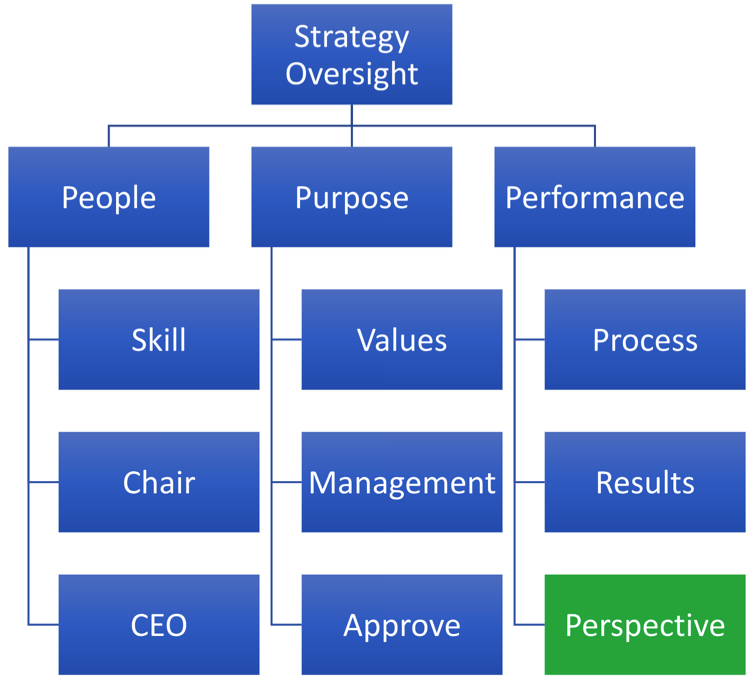
PERSPECTIVE
One of the most powerful learnings from the Institute of Corporate Directors insert link www.icd.ca course is that the board’s main function is to provide perspective to strengthen management’s analysis and recommendations. Perspective comes from four directions: hindsight, oversight, foresight, and insight.
Hindsight – Reviewing what happened, comparing it to plans and expectations, what was different and why, what can we learn.
Oversight – Overseeing current performance and higher level issues that management may be too busy to deal with, or just not focused on, such as asset health, protecting the balance sheet, compliance with important regulations and covenants (we want to know the trends as they’re happening, and not hear of problems after the fact), protecting the customer base, protecting our talent, and protecting our reputation.
Foresight – What are the strategies and opportunities for the future, major risks such as technology (“if you haven’t been hacked, you will be” according to the IT gurus), competitor positions and strategies, customer positions and strategies, attracting and retaining talent.
Insight – This is the real value of a high functioning board where they combine their experience, expertise, and distance from the day-to-day to see issues and opportunities that management might not be able to see.
A high functioning board manages the information flow and the agenda to ensure they are spending most of their time on the future, not the past. Where is your board focused? How can your management team provide better information, faster, to your board?
As a director or company owner of a privately-held company, how is your organization obtaining perspective in the areas of hindsight, oversight, foresight, and insight?
The Board Manifesto
I’ve written a ten-point manifesto for boards and business owners who want a board, want to improve their existing board’s performance, or don’t want a board but want to ensure all their bases are covered. If you’d like a free copy, please give me a call or send me an email at [email protected]


