What's Your Dashboard Part Two
We are continuing our discussion on your business dashboard that we started.
Most accounting reports only focus on the past. You can’t drive your car by looking at the rear view mirror, and you can’t run your business just by looking at historical financial statements. Your accounting system isn’t a dashboard, but it can be.
Here are powerful financial metrics that will enhance your dashboard.
Net to gross – this percentage measures your bottom line profits compared to your top line revenue. If you measure one financial trend in your business, this should be it! A negative number indicates that you are working harder to earn less and that’s very dangerous. To improve this, ensure that your pricing is generating higher margins. Profit percentage needs to grow faster than cost of goods sold and overheads.
Chart One: Net to Gross Percentage
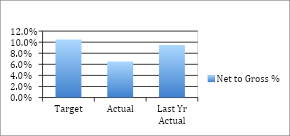
This chart shows that the net to gross is below target and below last year, indicating a declining trend that requires management intervention.
Days to cash – if it is taking longer to convert your inputs into cash, this will constrain your cash flow and reduce funds for future investments. You need to analyze your work flow and paper flow to ensure you are issuing invoices promptly and getting paid on time. To improve, obtain deposits on orders, invoice as quickly as possible, and, constantly throughout the month.
Days in accounts receivable – Divide your accounts receivable into your annualized revenues (=last month revenues x 12). If customers are taking longer to pay, they may be dissatisfied or they may be experiencing cash flow problems and thereby increase your credit risk of not getting paid.
You need to find out the cause and make adjustments to your operations, quality or credit limits. To improve, follow up assertively on day 31 and make immediate arrangements for full payments.
Take post-dated cheques if necessary. Offer discounts for payment within ten days.Days in accounts payable – if you are taking longer to pay your suppliers, they may get nervous, reduce your limits or put you on stricter terms and this can hamper your ability to service your customers.
Negotiate a discount for prompt payment ahead of time or ask for terms that match your customer’s payments to you. If you deal with large companies that pay in 60 days (meaning that your ‘days to cash’ is probably 90 days or worse), then obtain terms so that you can pay your suppliers in 60 days.
Chart Two: Sample dashboard.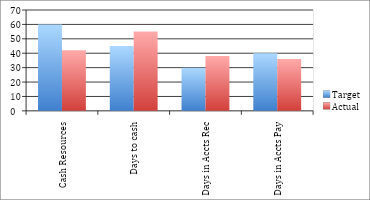
Chart Two shows you that you have less cash than your target, your days to cash are taking longer than your target, your days in receivable are taking longer, and your days payable is faster than your target.
These indicate that you are not realizing optimal cash flow, and this will eventually hamper your growth and profits.Product/service line profitability – you need to analyze each of your products, services, jobs, departments, customers, etc. by how much they each consume and contribute to your bottom line.
If your margins are declining, customers may be negotiating for better deals or see you as a commodity.
To improve: Take a proactive, consultative approach to your customer’s business, strengthen the relationship and offer multiple price points with higher value and profits.
A good accounting system will contain this information and allow you to export it into software where you can manipulate it and create custom reports. Remember, charts are more effective and powerful at communicating critical data quickly. If something is going wrong, you don’t want a printer spitting out a 30 page report, you want a red light blinking now!
A great accounting software system integrates your business operations with accounting data and will generate these reports automatically, without exporting and recalculating. This will give managers the critical information in real-time. It can even generate exception reports, like warning lights, so that you are only focused on important information that needs your attention.
From The Piggy Bank
Focus on very few powerful metrics that tell you where you are and where you are going so that you can have discussion and debate on improving future performance.


