Succession Two Step: Part Two – Ownership
Are your owner-manager roles separate, or are you a two-headed monster?
Many business owners think their position of owner-manager is a single position. It’s not. It’s two positions that are unrelated. Many problems occur when the owner thinks their status as the owner increases their skills or effectiveness as a manager. It doesn’t. Being an owner increases their position power, which is the least effective but commonly used (usually implied) type of power. But it doesn’t increase management power. And, that creates many obstacles in succession planning and in building an effective management team.
Is your status as the owner getting in your way of developing a succession plan?
Phil’s Profit Points™ in Brief:
Separating your management and ownership roles is critical to success in succession or transition plans.
Ownership should be a passive investment whereas management is an ongoing activity. Is your investment passive?
Ownership should involve proper governance in order to make management more effective. Do you have a functional board of directors or advisory board?
Structuring your business transition properly will increase the value of your passive investments and improve management effectiveness. Are you stepping on the gas, the brakes, or both?
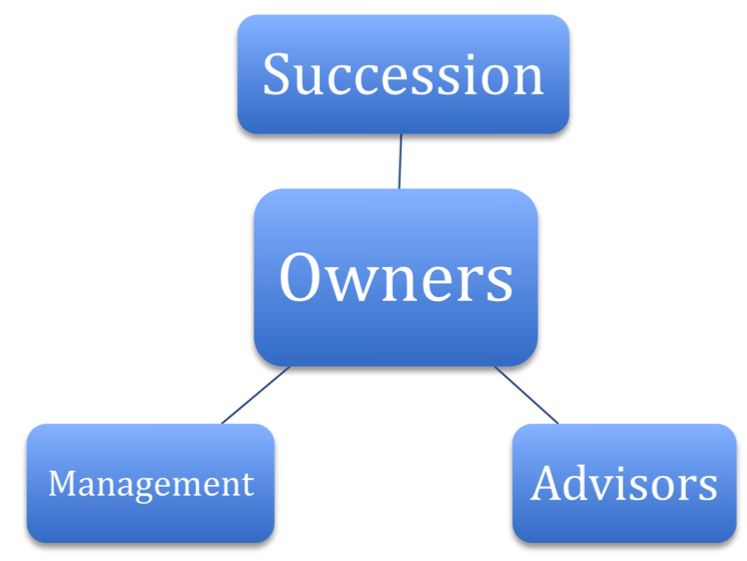
Figure 92.1: The Succession Team
The Second Step: Ownership
The owners or shareholders often appoint a formal board of directors, especially as a company grows or the number of shareholders increases. The board’s two main responsibilities are strategy development and succession planning in order to increase the value of the business and protect against foreseeable risks.
Strategy sets the future direction of the company, the markets and geographies it will be in, and how it will compete and grow. Succession planning develops and/or attracts people so that there will be talent on the bench in the future. These important functions may be delegated to the president but the board is still accountable for approval, implementation and results.
Here are several mistakes that we see owners make when undertaking succession planning.
There is no clear objective for the succession plan. For example, you might be doing a succession plan because your banker said you should…and that’s just to reduce their risk on your being the key person. A better plan is to focus on maximizing the value of the company over the next three years and to position it for a sale to a strategic buyer. What is your objective?
The owner’s objective is kept a secret but the managers and advisors are expected to develop and implement a plan. Is your plan a secret? Remember, you can always change your mind.
The owner is too involved in management. If you’re involved in the day to day, you need to be careful that you’re not trying to sell your own job. A business needs to run without you. Are you the value in your business?
Owners meddle in management. There may be an organizational chart and you may have good managers. However, if the “owner” says something needs to be done, everybody usually jumps to do it. This is a classic and common occurrence that I see frequently because the owner doesn’t respect their own organizational chart. Are you issuing owner’s directives to front line employees?
There is no board or it’s a puppet of the owner. A board should have strong debates about strategy and succession of key people. If ownership resides with a key person or group, the board can compliment the owner’s perspectives and provide a useful sounding board to improve decision making. Board members are also personally liable for certain government remittances so a board appointment is a serious responsibility. How does your board strengthen your ownership and company value?
The accountant minimizes taxes by claiming additional legitimate expenses (such as management bonuses) instead of advising how to maximize equity and valuation. This is a short-sighted approach that can hammer your valuation, make your business much harder to sell, and reduce your ability to attract capital and people. In other words, you can’t access the jet fuel and pilots you need to get your business to the next level. What are you doing to maximize the value of your business?
Failing to write the plan down. An owner may be going through the actions of developing and implementing a succession plan. However, if it’s not written down, it’s virtually impossible for the company’s professional advisors and the owner’s personal advisors to assist and add value. Is your plan written?
Failing to ask advisors for their perspectives and advice. Succession planning should involve your accountant, lawyer, banker, and financial planner. A good succession team has a leader or quarterback who can handle the advisors, get them in the room at the same time, and move quickly to developing a plan. Many advisors charge by the hour. The faster that you can get things done, the less it will cost you and you’ll avoid “succession fatigue” from working on a never-ending plan.
Not starting. There are always more urgent, important or exciting things to work on than your succession plan. However, as we mentioned in the last issue, it’s better to start at the kitchen table or boardroom table than wait until you are in the emergency room or funeral home. What are you waiting for?
Believing you don’t need one. If you don’t have one or two clear successors who are being groomed for management (that’s easy) and ownership (that’s more difficult because they need to show you the money), then you can’t wait and hope that someone will come and buy you on the day you decide to sell. They won’t. Or, if they do, it will be at their price, not at your price. What’s your plan? What’s your business worth today? How much do you want to sell it for and when? Or, how can you retain ownership but get out of management?
In Conclusion
You have options and choices, and need to hit the start button. As an owner, it’s your responsibility to develop a succession plan that will protect the value of your business and increase your personal wealth.
Tough Question
How have you separated your ownership and management roles and positioned your business for succession success?
**From the Vault **
Succession planning involves setting a date and value for your company and then building a team to help get you there.
Have a profitable week!
Please feel free to forward and share this newsletter! Thanks.


