Profit Potential Pricing Matrix Part I
How much additional profit could you generate if you enhanced your pricing matrix?
Here’s how you can assess your own profit potential.
When we perform Potential Profit Audits™ for our clients, the first step, as we discussed in the last issue, was to start with your production numbers. The second step is to analyze your pricing matrix. A pricing matrix is simply the different levels of pricing and bundling of your products and services.
Most businesses should have a pricing matrix. Here are a couple of common examples:
A restaurant uses a menu and often has ‘specials’ that provide extra value.
A car oil change specialist offers you different qualities of oil and different combinations of service (air filters, wiper blades) at different prices.
Both of these customer-focused pricing matrices can be used successfully in the business-to-business market. The first step is to take proactive control of the information and the customer’s decision process.
The key factor in developing a pricing matrix is to think from your customer’s perspective. Customers don’t just buy on price, especially in the business-to-business market. They may say they do, and they may even act that way occasionally, but, ultimately, it comes down to value choices. That’s why you need a pricing matrix.
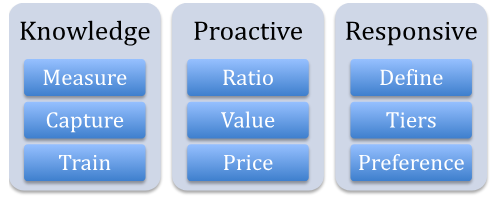
Value offerings to your customers are qualitative and quantitative. There are several important value factors that should be in your pricing matrix.
Your knowledge of your customer’s business. As your knowledge increases, it is more difficult and more expensive to replace you. Just make sure you don’t get complacent or arrogant, ever. For example, if you service industrial sites, your detailed knowledge of specific equipment and proper configurations can save your clients thousands or millions in lost downtime. That’s because you will be able to diagnose and repair faster than anyone else.
How do you measure your client knowledge?
How do you capture and distribute your client knowledge?
How do you train your people to use this client knowledge?
Your proactive vs. reactive ratio. My car tells me when the next service is due. My computer printer tells me when it’s running low on toner. However, our heating expert waits for me to call and schedule a service call for our furnace.
Being proactive is a key differentiator that sets you apart as a strategic partner instead of just a vendor. This helps you to dramatically increase your sales and profits. I know I’m speaking with a partner when they proactively recommend something that will save me money and reduce their future sales.
My computer and technology consultant, Kevin Pare at KSP Technology does this very well. He just installed a terminal server in our business. This increases our mobility and reduces our future hardware needs because we can access our server from an iPhone or an iPad and don’t need a full powered laptop. Because of my trust in Kevin, I refer my clients to him, and they will end up with powerful technology solutions that will help their businesses, too.What is your proactive vs. reactive ratio?
How can you be more valuable by being more proactive?
How would you price the proactive services?
Your responsiveness. One bank has an express line for business customers. Another doesn’t. I prefer the first one.
If you treat all of your customers equally, you are under-serving your best customers (how do you think they feel about that?) and you are over-serving (and under-charging) other customers. In other words, your best customers might be subsidizing everyone else. Ouch!
How do you define and measure responsiveness?
How can you provide multiple levels of responsiveness?
Which customers prefer which level of responsiveness?
“One size fits all” isn’t a pricing matrix; it’s the total absence of a pricing strategy. Developing a pricing matrix that represents multiple service options is the fastest and most effective method of increasing your profits.
Tough Question
Do you give your customers as many great choices as your favorite restaurant gives you?
From The Piggy Bank
Giving your customers choices makes them happier and makes you more profitable.


