Minimizing Taxes Is A Bad Idea
It’s that time of year when many business owners are meeting with their accountants and figuring out how to minimize taxes before their year end.
Here is what usually happens:
The accountant asks the business owner, “You’re having a good year. Would you like to minimize your taxes?”
The business owner, being a sane and rational person, provides the only reasonable answer to that question: “Of course!”
It’s the wrong question.
As a result of minimizing your taxes, several negative things happen to your business financial statements including:
Your expenses go up because of bonuses, management fees and other allowed expenses.
Your profits go down since the expenses went up.
Your cash flow goes down because you are paying other expenses.
Your business equity goes down because less profit is retained.
These will impede your ability to borrow, reduce growth and significantly decrease your business equity and wealth.
For example, if you have a profit of $500,000 and, assuming a corporate tax rate of 20%, you would pay $100,000 of tax. You would have after-tax net income of $400,000 which would increase your business equity (also known as ‘retained earnings’). Since banks typically lend up to twice your equity (if you qualify), this increase in your equity would typically increase your borrowing power by $800,000.
Whoa, that’s some serious cash. What could you do with an extra $800,000? Could you buy inventory more cheaply and pay suppliers faster? Could you buy equipment that would increase your speed and decrease your costs? Could you expand your business?
If your accountant ‘bonuses down’ (this is legitimate and frequently used) your profit to $100,000 – because you asked them to – by declaring a bonus to you of $400,000, then you save the corporate tax of $80,000 ($400,000 x 20%) and only pay $20,000. Whew, that’s a relief. Or is it?
You still have to pay personal tax on the $400,000 of bonus that you received, but it can likely be deferred for a year or longer. In the grand scheme of things, you haven’t saved tax, you’ve only deferred it. This cycle then keeps repeating itself.
In the second example, your business equity goes up by $80,000 ($100,000 of profit less $20,000 in tax) and you increase your borrowing power by $160,000 (assuming a debt-to-equity of two to one). That’s a lot less than the $800,000 increase above. And, there is still a very large personal tax bill looming.
I’ve met many bankers who role their eyes when they’re looking at financial statements that show low or no profit and no tax, yet the owner wants to borrow money to fund the steadily increasing sales. “Focusing on taxes instead of growth hurts most business owners,” one senior banker told me.
The bottom line is that tax strategies should never drive the bottom line.
You can’t grow your business and increase your wealth by focusing solely on how much tax you pay. That’s like driving slow (50 km/h) on the highway because it burns less gas. However, it takes twice as long to get anywhere, you waste a whole bunch of time, and you risk getting in to an accident because you’re slowing everyone else down. Your car was designed to maximize its fuel efficiency at highway speeds.
Your business can be designed for maximizing growth by paying some tax and wisely using leverage to accelerate your profitable growth.
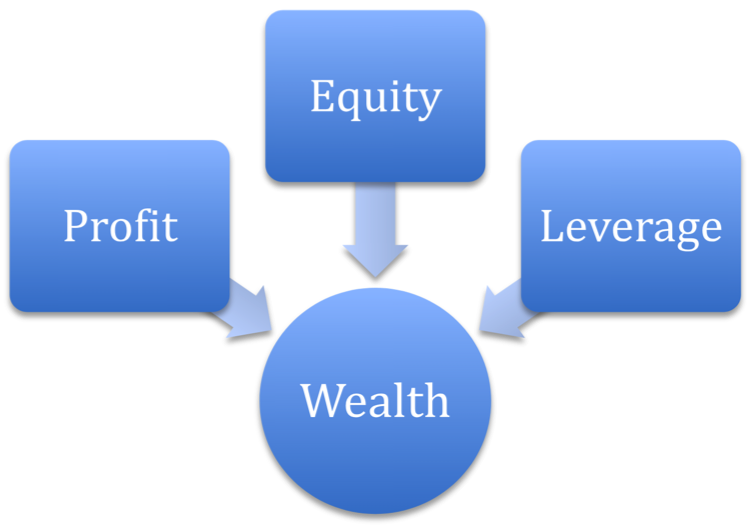
There’s no slow lane on the highway to high profits. How fast are you growing?
Tough Question
How much larger and more valuable would your business be if you didn’t minimize taxes and, instead, leveraged the equity to fund growth?
From The Piggy Bank
Don’t ask your accountant how to minimize your taxes. Ask them how to maximize your wealth.


