
Gross Points
Improving Cash Flow
This article will help you to improve your cash flow by focusing on the three main factors of cash flow.
Phil’s Profit Points™ in Brief:
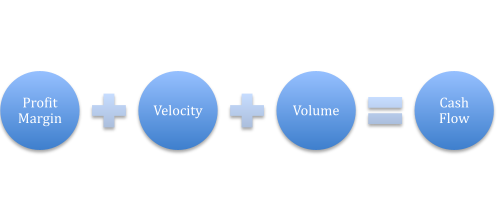
Cash flow depends on three factors: profit margin, velocity and volume.
Profit margin means how much gross profit is generated from the sale of every product or service unit.
Velocity means how long it takes to get paid, from initial input costs to final payment.
Volume means how many units you can produce and sell.
Profit Margin
Most accounting systems can show the cost of sales which includes direct labour, materials and other costs that vary with production. Revenues minus cost of sales equals gross profit margin. Increasing your profit margin can be accomplished in two ways: increasing your price or decreasing your variable costs of production.
Most businesses can increase their prices by improving their marketing message and strengthening their value proposition to their customers. By focusing on the factors that are important to your customer, you can become more valuable and therefore charge a premium. Even in a commodity business, there are opportunities to differentiate the service component of your entire customer transaction experience, from ordering to delivery and payment, that can make it easier for your customer to do business with you.
Velocity
Velocity is about the speed of payment. This is often under-estimated by most business owners. You pay your employees every two weeks or, if you’re lucky, twice a month (we recommend semi-monthly, it makes the cash flow smoother and avoids the two months that have three payrolls). You probably pay your suppliers every 30 days.
The faster that you can generate sales and get paid, the faster your velocity. If your customers can pay you a deposit to secure their future production and sales order, that helps out with velocity. Offering electronic payments and discounts for prompt payments can accelerate cash inflow.
If you sell to large companies, they may take 30 to 60 days (or longer) to pay you. That slows down velocity. Some large companies take great care of their suppliers and pay within ten days. Just ask, and offer something in return.
Volume
If it takes one week to produce something that, for example, costs $500 in labour and $500 in materials, each unit of inventory costs $1,000 plus an overhead allocation. Now, consider inventory, for example. If there are 1,000 units in inventory, that’s $1 million of cost sitting in inventory.
If your monthly sales are $1 million (or 1,000 units), then one month of inventory is about right and you’re selling 12,000 units per year. If your monthly sales vary between $250,000 and $500,000 then it can take up to four months to turnover your inventory because you’re only selling 3,000 to 6,000 units per month. That requires lots of working capital to carry inventory for a long time.
Sales volumes drive cash flow. That’s why I’ve often repeated my wise accounting professor who said, “Businesses don’t have cash flow problems. They have marketing problems.”
Cash flow, as a definition, is too vague to improve. Analyze your business from the specific perspectives of gross profit (dollars and percentage of sales), velocity and volumes to determine which areas are strong and which are not. Building on your strengths will improve your cash flow quickly.
Tough Question
What are your gross profit margins by product and service line, velocity and volume?
From the Piggy Bank
Divide and conquer: focus on each factor - profit margins, velocity, and volume - to improve your cash flow.
Have a profitable week!


