Effective Oversight of Strategy – Management’s Role
This week, we’ll continue our discussion of strategic oversight by exploring the Purpose, which is the actual formulation, evaluation, and approval of your strategy.
There is a lot of important information here and I’m condensing it drastically to fit in a newsletter. If you want more information on any of these topics, just let me know, and we can have a conversation about how this can help you grow your business.
Figure 130.1 Management’s Role
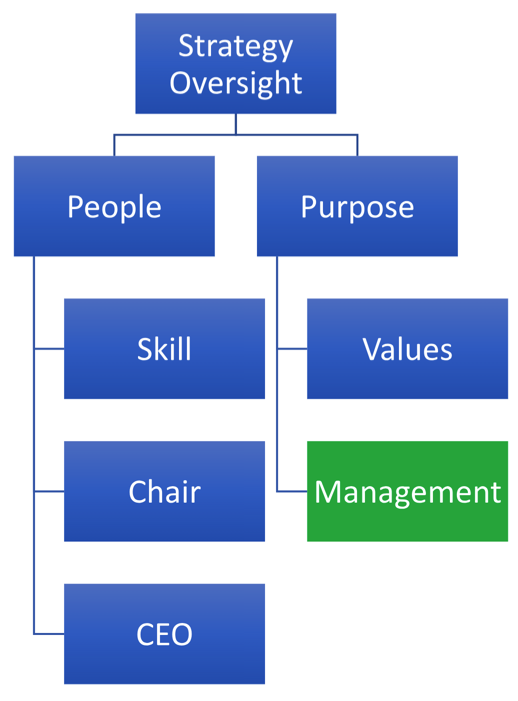
PURPOSE
Your business purpose is about your strategy. In other words, it’s about how you provide value to customers in a way that creates a long term, sustainable, differentiated, competitive advantage for your business.
Management
It’s management’s job to create the strategic plans and operational business plans and budgets that guide the business into the future. It’s the board’s job to evaluate and enhance these plans.
Plans – a business needs a plan. If it’s not written down, it’s not a plan. A strategic plan is about the long-term and overall strategic direction of a company in the current market and in the future. A business plan tends to be more operational and more short term in nature, typically the next operating year. A budget is how you will allocate your financial resources to drive your growth. If you use a rolling five quarter or thirteen-month budget, the annual budgeting process will be eliminated and you will constantly have a relevant budget, and remember to include CapEx. How confident are you in your strategic plan, business plan, and budget?
Metrics – as you know, “what you can measure, you can manage.” When we played street hockey as kids, we always kept score, because the score mattered. Metrics allow you to track progress on your major strategic initiatives, short term business plan goals, and performance against your budget. By using an exception-based report that flags variances outside of acceptable parameters, you can have a real-time reporting system on your business. Metrics can be objective and subjective. They just need to be reported. Reporting increases accountability, and accountability increases performance. What’s the score in your business? How are you tracking progress on strategic initiatives?
Timelines – does your company struggle with trying to get too many unimportant but urgent things done in a day and not enough strategically important things done in a year? Public companies are aiming to meet their quarterly goals which they publicly committed to in last quarter’s report and call. Yet achieving quarterly targets is short term thinking and may not demonstrate strategic discipline. Timelines create discipline and discipline creates results. Focusing on accomplishing strategic goals in the long-term can be much more important and valuable overall than chasing short-term numbers like some public companies have chosen—yes, it’s a choice—to do. Here is what Ewen Morrison, president and founder of EMW Industrial says about goals and timelines. “If we slay a one-eyed giant every month, we’ve made progress on 12 important goals during the year. They may be steps towards a major strategic initiative, but they’re progress on what’s most important for my company. We’re not just chasing short term numbers, we’re building long-term strategic capacity to support future revenue growth.”
Approve
It’s the board’s role to oversee the plans, challenge the assumptions, add value and perspective from their broad experience and skills, and finally, to approve management’s plans. This involves art, science, tact.
Skepticism – a good board doesn’t just enforce policy and act like a traffic cop, they ask questions based on their broad experience to help management build a better plan and build a better business. I had an auditing professor once tell us to be prepared to answer a question with, “Yes, your honour, I was aware of the situation and the decision.” We want our decisions to pass the test of being in court or being on the front page of the newspaper.
Would you be more skeptical knowing that someone else—the courts or the media—might be second guessing your decision process?
Skepticism is about testing the assumptions, according to Larry Hilworth, a successful entrepreneur and former banker
Considering that we all have biases, what biases are driving management to pursue their current plan?
Enhance – skepticism, asking questions, and thinking long-term will help you to enhance any plan. The key is to have a positive working relationship with the CEO and senior management team so they see you as valuable advisors and not traffic cops. In privately-held companies controlled by a majority shareholder, it takes a strong board to be proactive, challenge, and improve on a driven entrepreneur’s plans. Yet we are all smarter together than alone. By proactively acknowledging and dealing with the challenges of group thinking and bias, and framing advice in the best interest of others, we can enhance plans that will create value for customers and wealth for shareholders.
Approve – as a former hockey referee, some of my calls were instant reactions as there was no time to think, only react. Although boards are dealing with limited information compared to management and tight time frames, boards have time to think. Thinking time is made much more effective by developing and following processes. Early in my officiating career, I did learn that you get respect for the calls you make, not the ones you let go. It’s the same for a board. They need to approve, or challenge appropriately, for the benefit of the organization. Again, it’s all about the process. The courts will punish you if you don’t follow a process, but they will not question your business judgement if you did follow a process. What’s your process to approve strategic initiatives?
The key of all good governance is for the board to have, and follow, a process to oversee business performance and ensure that it’s aligned with the overall purpose.
If you’d like help on enhancing the strategic oversight function of your board and executive team, give me a call.


