Cash Flow as Valuation Driver
How to Increase the Value of Your Business
Part II: Improving Cash Inflow
This article will be of interest to you if you are thinking about selling your business, are applying for financing, or just want to make your business great!
Phil’s Profit Points™ in Brief:
Increase your business value by improving net cash flow and decreasing risk.
Improve cash flow by strengthening your profit margins, increasing sales volumes and accelerating speed of cash collections.
Use financing appropriately to support accounts receivable, inventory and accounts payable, or to fund asset purchases.
Last issue, we discussed that there were three major factors that impact the value of your business: management, cash flow and business strategy. In this issue, we’ll discuss the second factor, cash flow. Specifically, we’ll discuss how to improve the inflow of cash.
Cash flow is used to value a business when the business is fairly stable and mature. If your business is in a high growth mode, you would use an earnings approach to valuation, and we’ll discuss that in the future.
A race car driver will plan the race strategy based on fuel management, competitors, the weather and other factors. Too many pit stops to refuel can cost them the race. It’s the same in business. If you need to keep stopping for cash, it will distract you from running and growing your business. That’s why cash flow is a good predictor of business value. It’s a sign of a well-managed company.
First, a definition: cash flow is different than profit. Cash flow is the receipt and disbursement of cold, hard cash, regardless of when you made the sale or incurred the expense. It’s surprisingly easy for a profitable business to run out of cash, especially rapidly growing businesses.
When valuing a business using its cash flow, valuation factors that affect the discount rate include the buyer’s perception of risk and the stability of cash flows. Therefore, you want to increase the net cash flow, while reducing the risks of future cash flows, in order to maximize the value of your company.
Specifically, cash flows in from your gross profit margin on each sale, the volume of sales, how quickly you collect on those sales and external investment or financing.
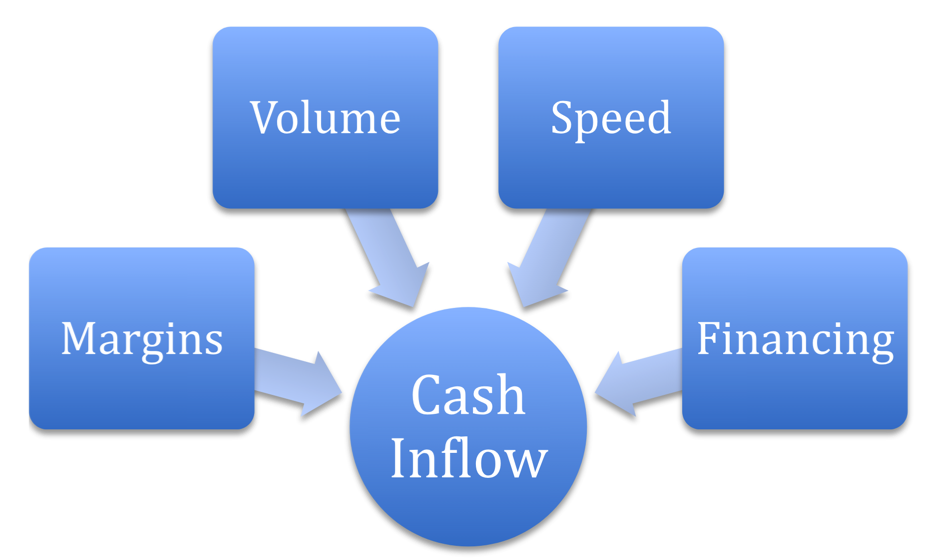
Here are tips to accelerate cash inflow:
Margins
Raise your prices! The most common problem that I see in businesses is that their price is too low because they don’t see the value from their customer’s eyes. You provide great value and you deserve to be compensated properly.
You can always offer discounts to your best customers, high volume customers or for fast payment, but stop leaving money on the table every time.
Know your numbers. I’ve actually told some clients that they would lose less money if they gave their customer a hundred dollar bill upon receiving the order and then sent the customer to their competitor.
Remember, pricing is part art and part science.
Volume
To increase volumes, be proactive!
The number one way to increase sales is to ask for the order. Don’t sit around waiting for the phone to ring.
Ensure that your inventory is turning over quickly and that you liquidate or return any obsolete or slow moving inventory.
Speed
There are several ways to accelerate cash inflow.
Obtain deposits from customers.
Issue an invoice as quickly as possible. Don’t wait until the end of the project. Send an invoice during stages, phases, percentage complete, or on a monthly schedule.
Accept wire transfers and electronic deposits.
Accept all credit cards. The customers get their points and you get paid immediately. If the 2% credit card fee is a deal breaker, your margins may be too low.
Aggressively manage your accounts receivable. Follow up on all late payments. Get post-dated cheques and restrict future business.
Don’t be your customer’s banker.
External Investment
The basic concept is that you want to match cash flows to the type of asset being acquired or expense being incurred.
If you have high quality accounts receivable with companies who take thirty or sixty days to pay you, then you would want an operating line of credit from a bank to provide short term cash while you wait for your customer payments.
Use external bank financing or leasing to acquire equipment. You don’t need to pay cash.
To reduce risks of future cash flows, strengthen your customer relationships so they remain loyal and don’t view you solely as a commodity provider that must compete on price, use written contracts, and take a collaborative role to help your customers maximize their long-term success.
Race car drivers plan their race strategy, especially in the final laps, based on their fuel supply, not their speed. Maximizing your cash inflow will help fuel your business growth and build long-term equity.
Do you want to improve your cash flow?
We are offering a new service to qualified small businesses, called Remote Profit Mentoring™, to help you manage and improve your financial performance.
This is an ongoing monthly service where we analyze your monthly results and make recommendations to help you increase profits, improve cash flow and build your business value. If you want to discuss our financial consulting services, or to see if you qualify for the Remote Profit Mentoring, please call us at 855-904-0087 or send an email to [email protected]
**Tough Question **
How much cash did your business generate last year, last month or last week?
From the Piggy Bank
Profits predict, but don’t guarantee, positive cash flow.
Have a profitable week!


