
13 Profit Tips
A start-up business owner recently asked me why his bottom line was so low. The start-up showed great revenue growth and customer retention, but had an extremely low net income as a percentage of revenue. He thought the overheads were too high. It turns out that the gross profits were actually 21% when the business plan target was 30%. If the business was able to achieve its 30% gross profit target, it would have had a very healthy bottom line. We discussed focusing on profits instead of pure revenue growth.
Any business owner is sitting on a wealth of opportunities to increase profits in their business. Today, we’ll discuss 13 tips to help you jump start your profits.
Phil’s Profit Points™ in Brief:
It’s more important to focus on profits than revenues because profits create wealth.
Measuring profits as close to your customer as possible is the key to profit improvement.
You can’t shrink your way to greatness, according to Tom Peters, but you can definitely tighten up your overheads and stop some invisible profit leaks, according to me.
C = M V 2 where Cashflow = Margin X Volume X Velocity. The more cash that your business generates, the more you can fund and fuel your own profitable growth.
Figure 89.1 Profit Tips
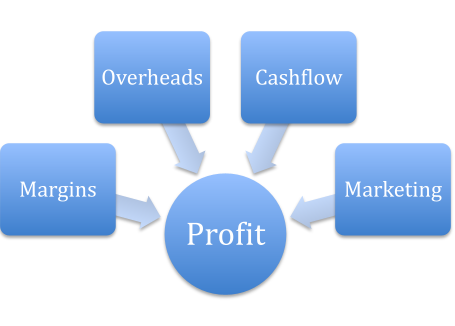
Gross margins are the markup on your product and service. If you sell something for $100 and it costs you $75, then the gross profit is $25 and the gross margin percentage is 25% ($25/$100).
The first step is to know your gross margin percentages on all of your main product lines and services.Now that you know the gross profits by product and service line, you can determine who your most profitable customers were last year. The data may surprise you. Your most profitable customer is probably not your largest customer that gets price discounts and takes a long time to pay.
Your most profitable customer is probably someone who values your expertise, doesn’t pressure you on prices continually, and sees you as a strategic partner and not just a vendor. The 80/20 theory will likely apply where 80% of your profits are generated by 20% of your customers. These customers are most likely in your “sweet spot” where you can generate the best profits.The next step is to set minimum gross margin percentages for your major product and service lines. Then, set prices above the minimum, based on value to the customer, uniqueness, competitive advantage, scarcity and your brand strength.
For example, if it’s an industry standard to sell widgets in boxes of 12, but your customer only needs two, you could sell smaller lots at a higher price that would improve your profits while improving your customer’s working capital (and their profits).Analyze how your customers purchase your products and services so that you can determine ways to make it easier and more convenient for your customers to do business with you.
When you understand your customers’ purchasing behaviours, you can develop new products, services, bundles or packages that can be more appealing to your customers.
For example, a software company could offer customized training for both the direct users and the indirect users such as managers that read reports.Overheads are the fixed costs that you incur to run your business. Practically all costs are fixed in the short-term, so reducing your overheads takes a long-term approach.
Review all of your contracted services and negotiate with your vendors. This includes cell phones, internet service, bank charges, janitorial and every other expense listed on your income statement in the General and Administration Expenses section.
If your janitors clean every two days, you can move them twice per week. In a four week or twenty day month, that reduces their expense from ten cleanings to eight cleanings, and saves you 20%.That 20% savings flows to your bottom line and to EBITDA. For every overhead reduction of $100,000, that will represent an increased business valuation of $300,000 to $500,000, assuming valuation multiples of three to five times EBITDA.
Cashflow is a function of gross margin (discussed above), volume of sales and velocity of payment. We’ll discuss sales volume in the marketing section below. The faster you collect your cash, the less you have to borrow to finance your working capital.
To improve cash flow velocity, collect customer deposits on major orders, issue progress invoices for large projects or large orders, offer a discount of one percent for payment within 15 days, increase prices to customers who are slow payers, aggressively collect any outstanding accounts receivable once they hit 31 days, educate your customers at the time of sale of the importance of prompt payment.
Accept credit cards for payments, and fire chronically slow paying customers.Marketing is about getting your phone to ring; and sales is about getting the customer to sign on the dotted line. The most important part of marketing is your brand; that is, how your customer perceives your quality and value.
The stronger your brand, the less price sensitive your customers will be. The waiting list for a new Ferrari is two years. Those customers don’t negotiate on price.
This is a huge attitude shift for many business to business entities: you are not just a vendor competing on price. You have significant customer knowledge and value and you need to be compensated for that expertise.Price your products and services based on the value to the customer. This will require an intimate knowledge of how your customer uses, and benefits from, your products and services.
Spending time with your customers to see how they order, receive, store, distribute, utilize and then benefit from your product and services will be an enlightening and extremely valuable experience that will position you to develop more useful offerings at better margins.Do not set your prices based purely on your cost or competitors’ prices. A competitor that has a lower price but can’t deliver on time isn’t a direct competitor if your customer needs something right away.
Improve your marketing. Many entrepreneurs come from the technical side of the business and grew organically, because the phone kept ringing.
They may never have had to strategically market their products and services. Well, with China aggressively growing their business model, improving quality and decreasing prices, you will eventually, if you haven’t already, feel the Chinese squeeze (it’s not a hug) on your business.
More importantly, attracting and retaining skilled labour requires you to market directly to potential employees. Also, don’t ignore your existing employees. Educate them first about the breadth and value of your goods and services, and they can educate your customers and prospects. Remember, everyone is in the marketing department.Once your overheads are lean, focus on increasing revenues by innovating new products and services and selling these new offerings to your existing customers who already know you and trust you.
This is much more effective than advertising to attract new customers. Most businesses can increase capacity and sales by 10% to 20% without significant capital expenditures. Therefore, all of the gross profits will flow to the bottom line, to increase your valuation and increase your wealth.The most important way to improve your profits: Raise your prices.
In Conclusion
Improving your profits involves business strategies to increase your value to your customers and tactics that increase productivity, efficiency and costs. Aligning your management decisions and actions on improving profits is a key step that every business owner needs to keep doing, every day.
Tough Question
What opportunities do you have to increase your bottom line by 10%, and what would be the impact on your business valuation and your personal wealth?
From the Vault
Profit is a function of price; and price is a function of your marketing, branding and value to your customer.


